Prioritisation for Engineering Managers: Make the Trade-Off Explicit
My first uncomfortable lesson about management was that finishing the list is no longer a realistic goal. New requests keep arriving alongside delivery commitments, people conversations, technical debt, and incidents.
Prioritisation starts with making the trade-off explicit: if this work moves forward, what moves back, who is affected, and who can agree to the change?
Aligning Priorities with Your Supervisor
Start with the outcome you and your manager expect the team to deliver. Then check that Product and other affected partners share the same understanding. A private priority list cannot resolve competing commitments across teams.
A quick habit: the “Monday sync” check-in
Bring a short update: “These are the priorities I am working to, this is the new request, and this is the decision I need.” Ask for a specific trade-off when necessary rather than waiting for a general disagreement to surface.
Example: A Customer Request Competes with Reliability Work
Consider this illustrative situation. The team has committed to removing a recurring source of production failures. Product asks for a customer feature in the same week, and the same engineer is needed for both.
First establish the facts: what customer outcome requires the feature, whether the date is fixed, what the reliability work prevents, and whether a smaller option is possible. Then make a recommendation:
We can deliver the smaller feature by Friday if we postpone the reliability change. That leaves the known failure mode in place for another week. My recommendation is to finish the reliability work and ship the feature next week. If Friday is essential, we need agreement on the remaining risk and a narrower scope.
The example does not say reliability always wins. It shows what decision needs to be made. Record the agreed owner, scope, timing, and any remaining risk so that “yes” does not mean different things to different people.
Introducing the Eisenhower Matrix
The Eisenhower Matrix, also called the Urgent-Important Matrix, can help sort work before that conversation. Importance is about the outcome or responsibility at stake; urgency is about how soon it needs attention.
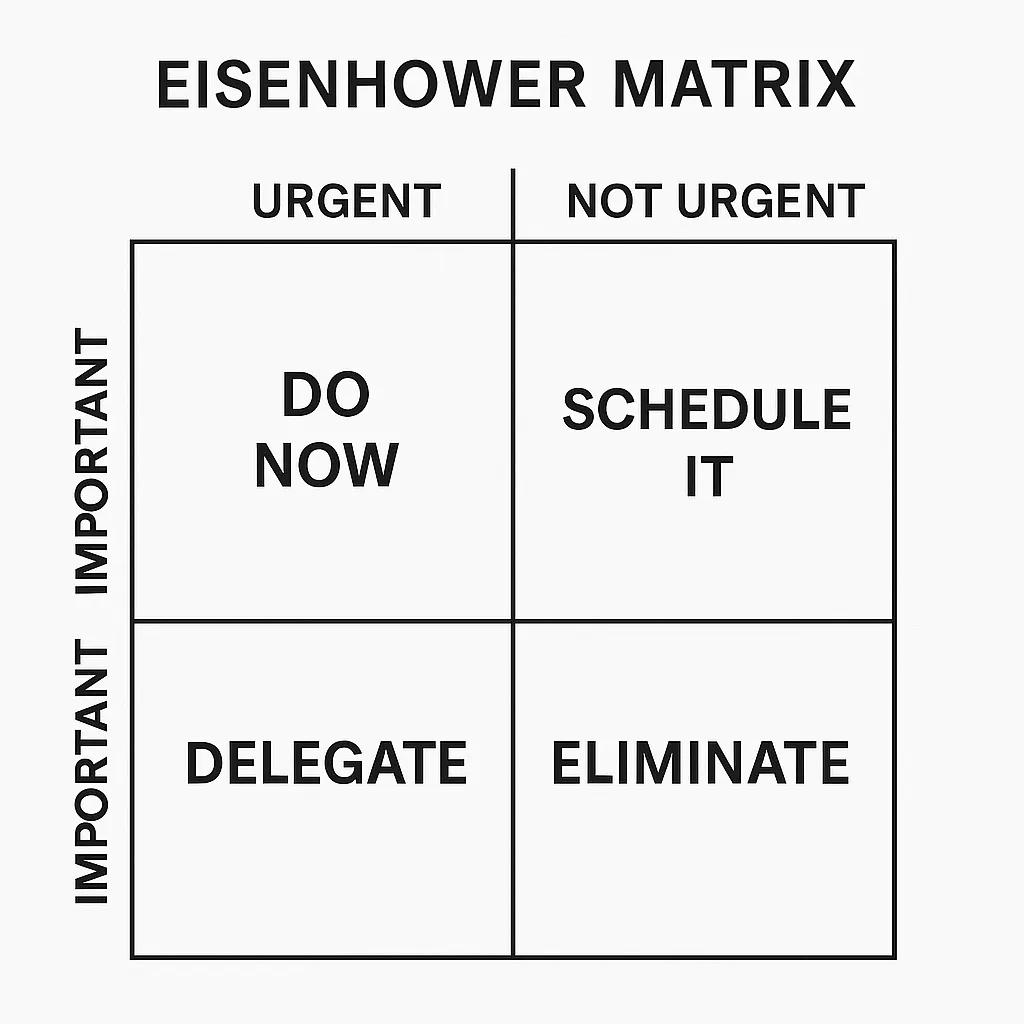
Urgent and Important: Respond
An active production incident may require immediate action through the established response process. Do not classify every senior stakeholder request as important solely because of who made it. Ask what happens if it waits.
Important, Not Yet Urgent: Protect Time
Development conversations, prevention work, and technical planning often lack an immediate deadline. Give them owners and time in the plan. Repeatedly postponing them can create the emergencies you later struggle to contain.
Urgent, Lower Priority for You: Check Ownership
A routine update may be better handled by its existing owner. Confirm that it is needed before passing it on. Delegation should not turn low-value work into somebody else’s interruption, and important work can also be delegated when the owner has appropriate support.
Neither Urgent nor Important: Stop or Defer
Question recurring reports nobody uses, speculative polishing, and meetings without a decision or useful exchange. Check for a real dependency before removing them; a task that looks pointless to you may serve someone else’s requirement.
Applying the Eisenhower Matrix as a Leader
Use the printable Eisenhower Matrix with the week’s actual work. Agree on the outcome each item supports and identify which commitments cannot fit together.
The matrix does not calculate effort, resolve dependencies, or choose between two important projects. In the feature-versus-reliability example, both may be important. You still need the trade-off conversation.
Saying No (Gracefully)
Make the constraint and next step clear:
- “We can take this on if we move the agreed improvement. Let’s decide which outcome takes priority.”
- “The smaller option fits this week. The full request needs a different date.”
- “I cannot commit another team’s capacity. Let’s involve the owner before promising that deadline.”
When work changes hands, use a clear delegation agreement. When nobody knows who can accept the trade-off, clarify decision authority.
The Question That Matters
At the end of the week, compare the work you did with the priorities you agreed. If interruptions displaced them, name the pattern and what needs to change. Counting completed tasks alone will not tell you whether the important work moved.