Delegate Ownership, Not Tasks
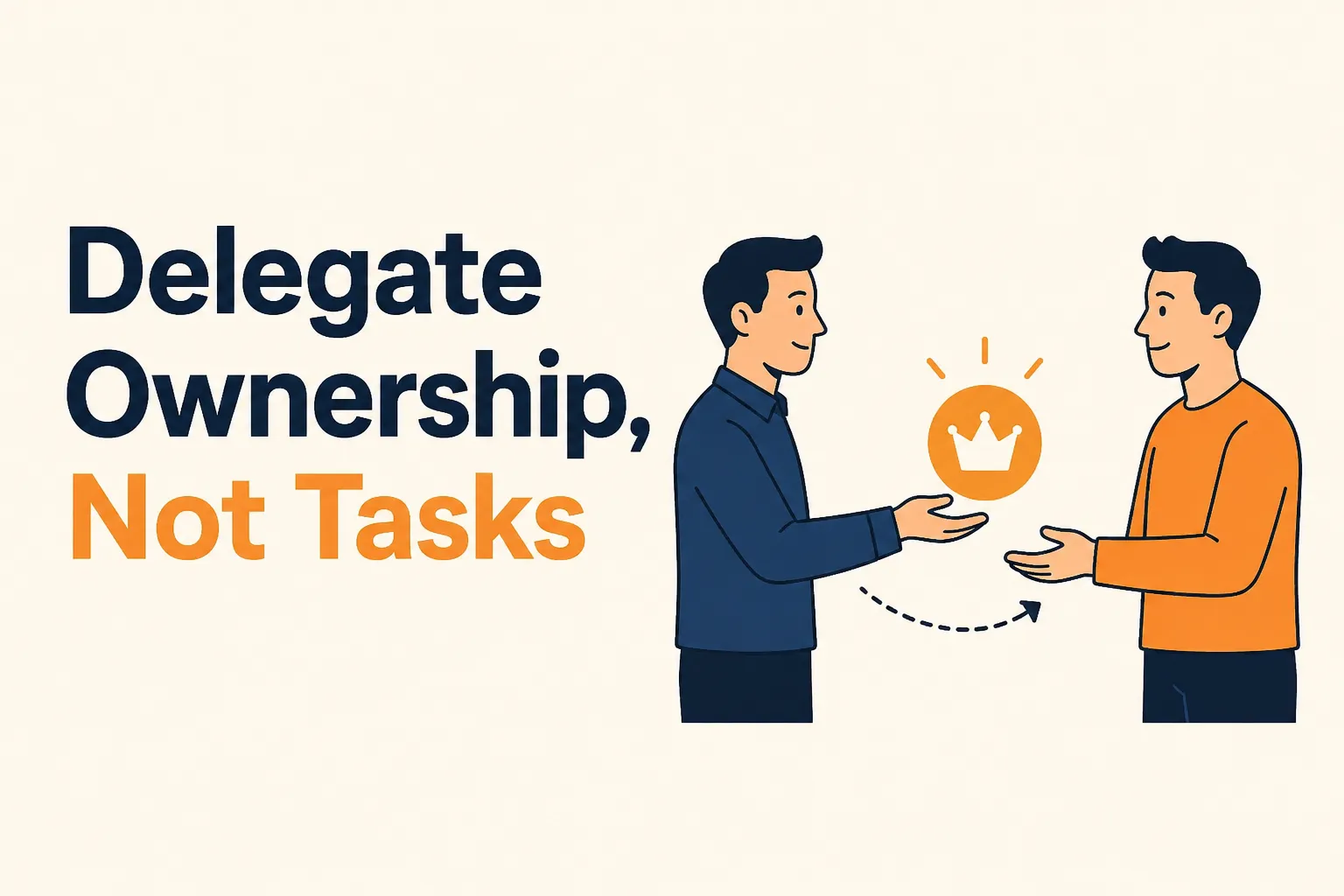
When managers talk about delegation, we usually talk about tasks.
Prepare this document. Run this meeting. Investigate this incident. Coordinate this release.
For a long time, this was how I delegated. The work moved to another person, but every meaningful decision still came back to me. People gathered information, prepared options and waited for my approval.
My to-do list looked better, but the team was still waiting for me.
I had delegated execution, not ownership.
The shift I needed was simple: delegate ownership, not tasks. Give someone an outcome to own, enough authority to make decisions and clear boundaries for when to involve you.
This sounds easy. In practice, many managers say, “You own this,” and then continue to approve every step. I have done it myself. I thought I was giving somebody an opportunity, but I was actually giving them more work while keeping control.
Real ownership changes where decisions happen. It also changes the manager’s role. You are still accountable for your team, but you do not need to remain the owner of every result inside it.
What Does It Mean to Delegate Ownership?
Delegating a task means asking somebody to complete an activity.
Delegating ownership means asking somebody to deliver an outcome and giving them room to work out how to achieve it.
The difference is not the size of the work. A large project can still be delegated as a list of instructions. A small improvement can create real ownership if the person has a clear result and the authority to make choices.
For me, ownership includes five things:
- A clear outcome.
- One named owner.
- Authority to make relevant decisions.
- Boundaries for consultation or escalation.
- A follow-up rhythm agreed in advance.
If one of these is missing, ownership becomes unclear. The engineer may have the work but not the authority. Or they may have freedom but no shared definition of success.
Task Delegation Is Only the Beginning
In my Effective Delegation Framework, I described delegation as Ask, Clarify and Follow Up. I use the Four W questions: Why, What, Who and When.
That is still the foundation. But when I want to delegate ownership, I need to answer another question:
Who is allowed to decide how the result will be achieved?
Imagine that I ask Tomek to improve the reliability of our release process.
Task delegation could sound like this:
Tomek, collect the failed deployment data and prepare three improvements for me to choose from.
Tomek has meaningful work to do, but I still own the problem. I choose the solution and remain the place where the decision closes.
Delegating ownership sounds different:
Tomek, I would like you to own the reliability of our release process. Our goal is to reduce failed deployments by 30% this quarter. You can change the process and tools together with the team. Please involve me if the solution needs additional budget or affects another department. Let us review progress every two weeks.
Now Tomek knows the outcome, the space he can operate in and the situations where I need to be involved.
This does not mean he has to do everything himself. He can involve other engineers, QA or SRE. Ownership means making sure the result moves forward and the loop gets closed.
It creates more responsibility, but it also creates room to grow. This is the kind of ownership I expect to see as a team moves towards the Performing stage.
Ownership and RACI Accountability
Ownership and accountability are closely connected, but I do not use them as interchangeable words.
In the classic RACI model:
- Responsible people do the work.
- The Accountable person is ultimately answerable for a specific activity or deliverable.
- Consulted people provide input.
- Informed people need visibility.
There should normally be one Accountable person for each activity in a RACI matrix.
This is where the scope matters.
Tomek could be Accountable for improving release reliability. I remain accountable for the performance of my team and for making a sensible delegation decision. I selected the owner, agreed on the boundaries and decided what support was needed.
We are not both Accountable for the same RACI row. We are accountable for different outcomes at different levels.
If the work fails, I cannot tell my manager, “It was Tomek’s problem, not mine.” At the same time, if I keep myself as Accountable for every deliverable, the team will continue to bring every important decision back to me.
The goal is not to remove accountability from the manager. It is to put accountability close to the work while keeping the wider management accountability clear.
Ownership Needs Decision Authority
You cannot ask somebody to own a result while keeping all decisions for yourself.
This is especially frustrating for experienced engineers. They hear, “You own this,” but every technical choice, priority change or conversation with another team still needs manager approval.
That is responsibility without control.
When I delegate ownership, I try to make three things clear.
What can you decide alone?
These are decisions the owner can make without asking for permission. They may share the decision for visibility, but approval is not required.
What should we discuss first?
Some decisions affect another team, require budget, change a public commitment or create a difficult-to-reverse architecture choice. These need consultation before moving forward.
When should you escalate?
Escalation is not failure. We should agree on signals that mean the risk has moved outside the delegated area: a deadline is in danger, production is affected or an external dependency is blocked.
Without these boundaries, people usually choose one of two options. They ask about everything, which keeps the manager as a bottleneck, or they make a decision the manager did not expect, which damages trust.
Delegate the Outcome, Not Your Method
When I explain exactly how the work should be done, I leave little space for ownership.
Sometimes detailed direction is necessary. A person may be learning, the risk may be high or there may be only one safe process. But it should be a conscious choice, not my default way of delegating.
For most delegation, I want to be clear about:
- Why this matters.
- What result we expect.
- Who owns the outcome.
- When we need the result.
- Which decisions the owner can make.
- Which boundaries require discussion.
- How we will follow up.
The first four points come from the Four W delegation framework. Decision authority and boundaries are what turn a handoff into ownership.
What is deliberately missing is a detailed instruction for every step.
If I need somebody only to execute a known solution, I should be honest about that. There is nothing wrong with task delegation when that is what the situation needs. Problems start when I call something ownership while expecting the person to follow a plan that exists only in my head.
Follow-up Does Not Take Ownership Back
Some managers avoid follow-up because they want to show trust. Others check every detail because they are afraid of losing control.
Neither approach works well.
Delegating ownership does not mean disappearing. A leader still provides context, removes blockers and checks whether the outcome is moving in the right direction. I prefer to agree on that rhythm during the handoff, not after I start to worry.
For a small area, a weekly update may be enough. For a risky change, it could be a short check-in twice a week. The purpose is to exchange context, notice risks and offer support.
I like questions such as:
- What changed since our last conversation?
- What decisions did you make?
- Where do you see the biggest risk?
- What do you need from me?
These questions leave the ownership with the person.
“Show me everything before you continue” sends a different message. It teaches people that the manager is still the real owner.
Where Delegating Ownership Goes Wrong
The first problem is shared ownership. When five people own the same outcome, usually nobody feels responsible for closing it. One owner can involve many people, but I still want to know where the final decision sits.
Another problem starts with a sentence that sounds empowering: “Do whatever you think is best.” Without boundaries, this creates anxiety rather than freedom.
The opposite is just as damaging. Expecting somebody to own a result while requiring approval for every decision gives them responsibility without authority.
There is also a temptation to disappear after the handoff. That is not empowerment. It is abandonment. Taking the work back as soon as the first problem appears is not support either. Sometimes my job is to ask one useful question, remove one blocker and let the owner continue.
The level of authority should fit the person’s experience and the risk of the work. Good delegation is not all or nothing. You can increase the space as trust and capability grow.
Check What You Actually Delegated
I now use a simple check after delegating. Can the person explain:
- The outcome they own?
- The decisions they can make?
- The boundaries they need to respect?
- The situations in which they should involve me?
If not, I probably delegated work, but not ownership.
As an engineering manager, you remain accountable for your team. Delegating ownership does not change that. It gives people meaningful outcomes inside the team and puts decisions closer to the people who understand the work.
That leaves two practical questions:
- How do we clarify who is Responsible, Accountable, Consulted and Informed when work crosses roles or teams?
- How do we decide which choices an engineer can make alone and which ones need discussion or escalation?
I answer the first question in RACI Matrix for Engineering Teams. For the second, use the four levels in Decision Tree for Engineering Leaders.
Together, these tools turn “Take ownership” from a vague expectation into something a team can actually use.
Look at one piece of work you delegated this week. If the owner still needs you for every meaningful choice, you moved the activity but kept the ownership. Decide which one of those choices you can genuinely hand over next.