RACI Matrix for Engineering Teams: Release Example and Template
A feature can be implemented and tested while nobody is sure who confirms it is ready to release. A RACI matrix makes those responsibilities explicit: who does the work, who owns the result, whose input is needed, and who needs an update.
On paper, ownership for a feature release looked obvious to me. Then a release was delayed, and that neat picture fell apart. Everybody had participated, but nobody could clearly explain who owned the complete result.
The questions were concrete. Who confirms release readiness? Who can postpone the rollout? Who involves Security, deploys the change, and tells Customer Support? When I asked around, the most common answer was: Not me.
The example below is a starting point for that conversation. Adapt it with the people doing the work.
What Is a RACI Matrix?
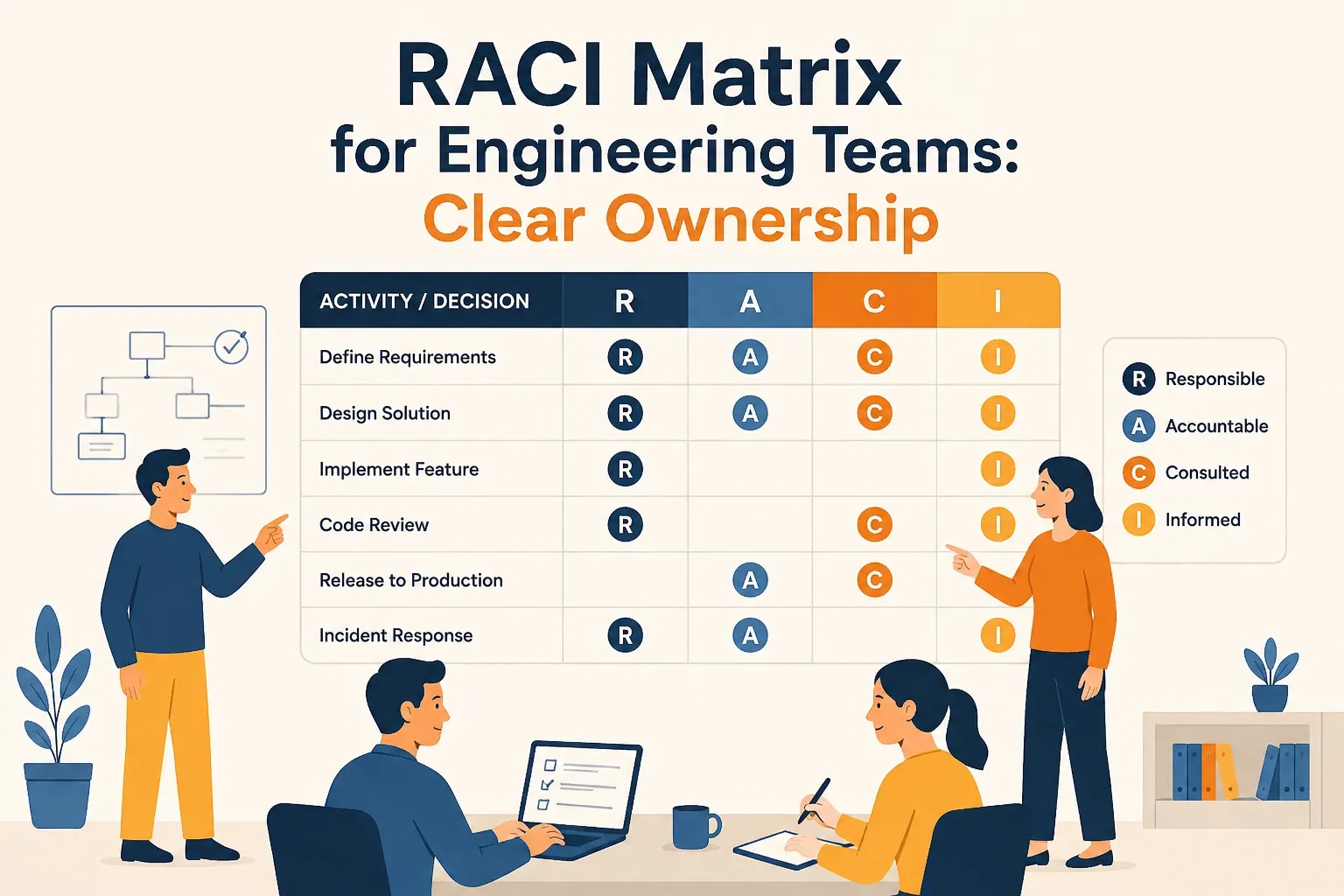
A RACI chart maps activities against people or roles. Its four letters mean:
- R — Responsible: carries out the work. More than one person can contribute.
- A — Accountable: owns completion of the result. Use one accountable owner for each row.
- C — Consulted: provides input before the relevant action or decision.
- I — Informed: receives an update without being part of the approval process.
The same role may be both A and R. An empty cell means no assigned involvement in that row; do not add letters merely to fill the chart.
The spreadsheet is not the useful part by itself. The useful part is the conversation it forces. As a Tech Lead, I could resolve ambiguity by stepping in and doing the work. As a manager, that habit made me the fallback owner for everything. RACI helped me surface those assumptions before another delayed release did it for me.
RACI Matrix Example for a Feature Release
This illustrative team has an Engineer, Tech Lead, Product Manager, Engineering Manager, SRE, and Customer Support. Testing is included in engineering work for this example; add a separate QA role if that reflects your organisation.
| Work | Engineer | Tech Lead | Product Manager | Engineering Manager | SRE | Customer Support |
|---|---|---|---|---|---|---|
| Define product scope | C | C | A/R | I | I | C |
| Design technical solution | R | A | C | I | C | I |
| Implement and test | R | A | C | I | C | I |
| Confirm release readiness | R | A | C | I | C | I |
| Deploy to production | R | A | I | I | R | I |
| Communicate the release | I | C | A | I | I | R |
Download the editable RACI release example and blank template. The file is Markdown: you can edit the tables in a text editor or import the content into your working documents. No email is required.
The template includes this exact example and a blank version. Before using either, confirm which roles exist, who has the authority to own each result, and what required approvals sit outside the chart.
Worked Example: The Feature Is Ready, but the Release Is Waiting
Imagine the Engineer has finished implementation and testing. Product assumes the Tech Lead will authorise the release; the Tech Lead expects the Engineering Manager to do it. Customer Support has heard that the feature is launching but has no confirmed update.
Start with the row Confirm release readiness. In this example, the Engineer supplies the evidence and the Tech Lead is accountable for closing the readiness decision. Product and SRE contribute the context needed before that decision. The Engineering Manager receives visibility rather than becoming another unspoken approval step.
Next, look at Communicate the release. Customer Support prepares or sends the communication, while the Product Manager owns its accuracy and timing. Someone being informed about a technical change is different from owning communication about it.
Finally, discuss the ambiguous boundary: can the Tech Lead postpone the rollout if the checks fail? Where does an externally committed date need escalation? RACI does not answer those questions by itself. Record the decision authority alongside the responsibility.
Read the Roles in Context
Responsible: Who Does the Work?
When two roles are R, divide their contributions explicitly. In the deployment row, the Engineer might prepare the release while SRE handles the rollout. Write down the handoff rather than assuming both people will infer it.
Accountable: Who Owns the Result?
Choose the person who can close the loop, not automatically the most senior person. In another organisation, an Engineering Manager or release manager might own readiness. If the named owner cannot obtain the evidence or approvals they need, the chart describes an aspiration rather than a workable arrangement.
Consulted: Whose Input Do We Need?
Name the input and when it is needed. Security may need to review an access-control change before implementation is complete. A C should not silently create a veto or override an actual approval requirement.
Informed: Who Needs Visibility?
Specify the update channel or occasion. Customer Support might need a confirmed launch note; the Engineering Manager may need a risk update. Neither necessarily needs another meeting.
How to Build a Useful RACI Matrix
Start with what has to happen
Choose one workflow with repeated ownership gaps. List deliverables at a level that exposes handoffs: scope, design, implementation, readiness, deployment, and communication. A row per ticket is usually too detailed; “deliver the feature” may hide the problem.
Use roles, then find the gaps
Begin with roles so the chart is reusable, then record who currently fills them. Check that every row has someone doing the work and one accountable owner. Resolve disagreements together before treating the table as an agreement.
Be suspicious of too many C’s
Ask what information each consulted person contributes. If nobody can explain the need, an update may be enough. Preserve mandatory reviews; simplification should not remove an actual control.
Build it with the people doing the work
Walk through a recent delayed release. Would the proposed chart have made the next action clear? What would still have been missing? Use the answers to revise it and agree when to review it again.
Common RACI Mistakes
A manager marked A in every row can become the same bottleneck the exercise was meant to remove. Two A’s can leave nobody able to settle a disagreement. An R without capacity can create a commitment that the person cannot meet.
Another failure is using C as a quiet way to say “approval required.” Consulted means input is needed; it does not automatically give somebody veto power. If approval is mandatory, write that control down explicitly.
Another failure is a chart that no longer describes the team. Review it when ownership, staffing, or the workflow changes. People need a current agreement, not a polished document about last quarter.
When RACI Helps Engineering Teams
Use it where work crosses roles or teams and a missed handoff has a meaningful cost: releases, migrations, or recurring follow-up work. For a familiar task within one team, a named owner and a short conversation may be enough.
For incident response, use the organisation’s response roles and escalation process. A planning matrix should not introduce a new approval queue during an outage.
RACI Does Not Define Decision Authority
RACI explains who contributes to an outcome. The Decision Tree for engineering teams helps explain which decisions the owner can make independently.
Use those distinctions when delegating ownership. The owner needs both a responsibility and enough authority to carry it out.
Use the Disagreement
Take one piece of work where “I thought somebody else owned that” has appeared. Download the example, adapt it with your team, and walk through a real handoff. The disagreement about a row is useful evidence of an assumption you can now resolve.